
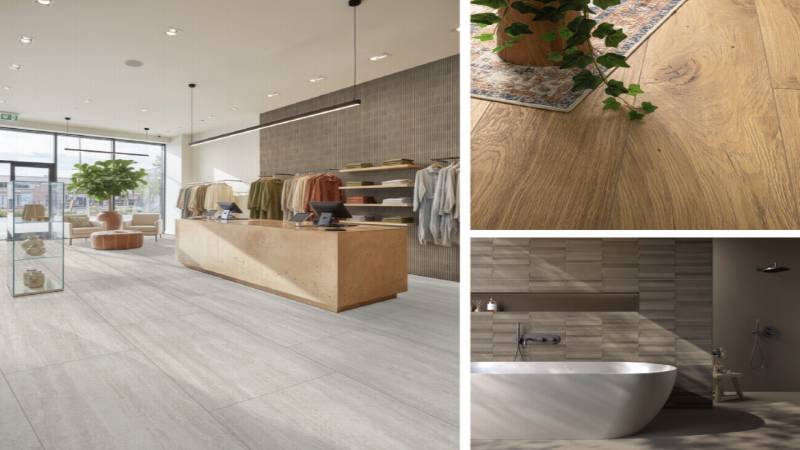
Porcelain tile grades across commercial, residential, and wet-area applications
The first step in choosing the right porcelain tile for your project is understanding how tile is graded. Porcelain tiles are not all created equal. Grade is what tells you where a tile will perform best, whether it’s on a decorative powder room wall or on the floor of a busy airport terminal. It takes into account durability, moisture absorption, slip resistance, edge precision and visual consistency — all of which contribute to how a tile wears and looks over time.
A wide range of high-performance porcelain tile collections are built to cover everything from light residential use to demanding commercial applications. Understanding how grading works makes it a lot easier to match a collection to the space it actually needs to fill.
Quick Overview: How Porcelain Tile Is Graded
A few performance standards combine to determine a grade for porcelain tile, such as PEI ratings, water absorption rates, slip resistance and visual uniformity. Tiles in Grades 1 and 2 are usually appropriate for walls and light residential use, whereas Grades 4 and 5 are constructed for high-traffic residential and commercial settings. True porcelain also has to keep water absorption under 0.5%, which is the technical line that separates it from standard ceramic.
Technical Standards: Tile Grades and the PEI Rating System
Murcia Clay
The Porcelain Enamel Institute (PEI) rating system is the industry standard for testing how well a tile resists surface abrasion. PEI testing is not about appearance. It measures long-term wear, essentially simulating years of foot traffic to see how a glazed surface holds up. The result is a 1-to-5 scale, and it’s one of the first specs worth checking before you settle on a tile for any given space.
Grade 1 & 2: Walls and Light Residential Use
Grades 1 and 2 porcelain tile are designed for areas with little to no foot traffic. Examples of common uses are:
- Backsplashes
- Decorative accent walls
- Powder rooms
- Low-traffic residential spaces
- Lighter-duty tile applications
Because these tiles don’t have to stand up to foot traffic, manufacturers can focus more on decorative detail, texture, and finish than on abrasion resistance, which is why so many of the boldest, most specialized patterns show up in this grade range.
Grade 3: The Residential Flooring Standard
Grade 3 is the standard for everyday home flooring. It holds up to routine foot traffic while still offering the design range homeowners want. Typical applications include:
- Kitchens
- Bathrooms
- Living areas
- Everyday residential flooring throughout the home
For the majority of homeowners considering a flooring upgrade, Grade 3 hits the sweet spot of performance and design flexibility.
Grade 4 & 5: Commercial and Heavy-Traffic Performance
At the top of the scale, Grade 4 and Grade 5 porcelain are designed for heavy, constant foot traffic. These grades are usually specified for:
- Airports
- Retail environments
- Hospitality spaces
- Multi-family projects
- Busy homes with children, pets or heavy daily use
Grade 5 in particular is engineered to withstand the heaviest foot traffic without showing surface wear, which is why it shows up so often in commercial and public-facing specifications where durability isn’t optional.
Edge Grading and Visual Consistency
Valgrande Quercia
Wear resistance isn’t the only thing that gets graded. Edge sharpness and visual uniformity play a big role in how a finished installation looks, particularly when it comes to grout lines and overall design cohesion.
Rectified vs. Pressed Edges
After firing, rectified porcelain is mechanically cut and ground to create sharp, even edges. This process allows:
- Tighter, thinner grout lines
- Greater dimensional consistency from tile to tile
- A modern, seamless look favored in contemporary design
Pressed-edge tile, conversely, comes out of the kiln with a slightly rounded or uneven edge, which often requires wider grout joints to accept that natural variation. Rectified tile is often the better choice for large-format installations and minimalist designs that aim for a clean, uninterrupted surface.
Understanding Shade Variation (V1–V4 Ratings)
Shade and texture variation ratings describe how much one tile can vary from another tile within the same product line:
- V1 – Uniform Appearance: Minimal difference between tiles, ideal for a solid color look
- V2 – Slight Variation: Minor tone changes that add more depth, but remain consistent
- V3 – Moderate Variation: Clear variation in shade and texture that mimics natural materials
- V4 – Substantial Variation: Significant tile-to-tile variation designed to imitate the look of natural stone or wood
Collections created to mimic natural materials such as a calacatta gold porcelain look, a travertine-look porcelain tile or a wood-look porcelain tile tend to fall higher on the variation scale. Knowing the V-rating of a product before installation will help you set the right expectations and plan for pattern repetition, especially in large floor areas.
Manufacturing Grade: Why Porcelain Outperforms Ceramic
Chateau Luna Blanc
Porcelain and ceramic perform differently, mainly because of the way they are made. Porcelain clay is denser, normally combined with sand and feldspar and fired at much higher temperatures than ordinary ceramic. That process, along with greater compression during forming, creates a tile with a much higher molecular density.
That density is the source of porcelain’s performance advantages: stronger resistance to chipping and cracking, better long-term durability underfoot, and a tougher surface that resists abrasion far longer than conventional ceramic.
The 0.5% Moisture Absorption Standard
One of the clearest technical differences between true porcelain and ceramic is water absorption. For a tile to be classified as porcelain, its water absorption rate has to fall under 0.5%, measured under ASTM testing standards. That low absorption rate has a direct effect on:
- Durability: Less absorption means less stress internally on the tile body.
- Freeze-thaw resistance: Low absorption prevents water from spreading inside the tile when temperatures drop below freezing, making it important for outdoor and cold-climate use
- Stain resistance: A tighter, less porous surface is inherently better at resisting stains
- Moisture protection – Ideal for bathrooms, kitchens and other wet areas around the home
DCOF and Safety Standards for Commercial Spaces
Wear resistance is not the same as slip resistance, which is measured by something called the Dynamic Coefficient of Friction, or DCOF. While PEI measures the abrasion resistance of a tile’s surface, DCOF testing measures the traction that same surface provides underfoot, especially when wet.
The slip resistance of porcelain tile is an important spec for:
- Commercial flooring
- Wet environments like locker rooms and pool decks
- Hospitality projects
- Healthcare facilities
The American National Standards Institute requires a minimum DCOF of 0.42 for level interior walking surfaces that are likely to get wet. On commercial or high-traffic jobs, it’s worth checking the DCOF as well as the PEI rating. A tile can be rated high for wear resistance but still not meet the slip-resistance standard required for its application. In general, textured and matte finishes tend to test higher for slip resistance than high-gloss surfaces. Keep this in mind early when narrowing down finishes for pool decks, entryways and other wet commercial spaces.
What Grade of Porcelain Tile Fits Your Space?
Cordova Lablanca R11
Choosing the right grade comes down to matching a tile’s performance profile to how the space will actually be used. It helps to start by narrowing down which porcelain types suit the project’s traffic and moisture demands. Worth considering:
- Traffic levels – light domestic use versus heavier commercial foot traffic
- Moisture exposure: Dry areas in the home vs. wet zones like bathrooms and mudrooms
- Indoor vs. outdoor use — freeze-thaw and slip resistance are much more important outdoors
- Residential versus commercial applications – commercial spaces usually require a higher PEI and DCOF rating
- Maintenance expectations – denser, higher-grade tile generally needs less long-term maintenance
The wide range of porcelain tile styles available can also help to narrow down a grade and finish that will satisfy both the performance requirements and the design goals for a room.
Best Tile Grades for Kitchens and Bathrooms
Kitchens and bathrooms need a tile that can provide moisture resistance, slip resistance, everyday foot-traffic durability, and stain resistance all at the same time. Grade 3 porcelain usually checks all those boxes, and knowing how to properly clean porcelain tile stains can help maintain that performance over the years.
Commercial Porcelain Tile Flooring Grades
Commercial flooring projects call for a higher grade overall. Before finalizing a project spec, specifiers should review the variety of porcelain choices available in a collection. Typical applications are:
- Hospitality environments, including hotel lobbies and restaurants
- Retail spaces with heavy daily foot traffic
- Office buildings
- Multi-family developments with shared common areas
The standard requirement for these settings is Grade 4 or 5 tile with a compliant DCOF.
Porcelain Tile vs. Ceramic Tile Grades
The differences between porcelain and ceramic go beyond the grading scale itself. Porcelain is denser and tougher than ceramic, and it absorbs significantly less water, giving it a real edge in break strength and long-term durability. Both materials can carry PEI ratings, but porcelain more often qualifies for the higher end of the scale — part of why it’s frequently considered the more durable flooring option for demanding home and commercial use. Ceramic remains a solid, budget-friendly choice for lighter-duty spaces, but porcelain is usually the stronger pick when durability is the priority.
Visual Guide to Tile Grades and Performance Ratings
PEI and V-rating reference chart
DCOF slip-resistance reference chart
Recommendations for Commercial Standards and Specifications
In addition to PEI and DCOF, architects, designers and specifiers should also consider several other standards on commercial projects:
- ASTM standards for water absorption and breaking strength
- Break strength requirements specific to the application
- Commercial installation tolerances for large-format tile
- Moisture criteria for below-grade or wet-area installations
- Safety compliance requirements tied to slip resistance
Tile Grades Explained: What You Need to Know
The different grades of porcelain tile can feel like a lot to track, but it really comes down to a handful of core specs: PEI rating for wear resistance, water absorption for durability and moisture protection, DCOF for slip resistance, and V-rating for shade consistency. Matching those specs to a project’s traffic volume, moisture exposure, and design goals is the fastest path to a tile that actually delivers on its promise. See more.
Frequently Asked Questions
What is Grade 1 porcelain tile used for?
Grade 1 porcelain tile works well for wall applications, decorative use, and other low-traffic areas that don’t call for high abrasion resistance.
Can Grade 5 porcelain tile be destroyed?
Grade 5 tile is very durable and very resistant to abrasion. It is a good choice for the heaviest commercial foot traffic. However, no tile is truly indestructible, and proper installation and knowledge of impact resistance limits are still important, especially in areas where heavy objects could be dropped.
How can I tell the quality of porcelain tile?
Start with the PEI rating. Then look at DCOF ratings, V-ratings for shade consistency, water absorption figures and manufacturing standards. A tile’s performance after installation is a function of how all of these specs interact.
What is the best PEI rating for kitchen floors?
A Grade 3+ rating is typically recommended for kitchen flooring, depending on household traffic and daily use.
Why are some porcelain tiles more expensive if they’re the same grade?
Digital printing technology, refined textures, tighter manufacturing precision, specialty finishes, and large-format production all add cost regardless of a tile’s wear-resistance rating — so you could have two tiles within the same PEI grade that land at very different price points.
Does the grade of a tile determine its slip resistance?
PEI grade measures wear resistance, while DCOF measures slip resistance. The two ratings are separate standards, and both are important to flooring performance. They should be evaluated individually, especially for commercial or wet-area applications.